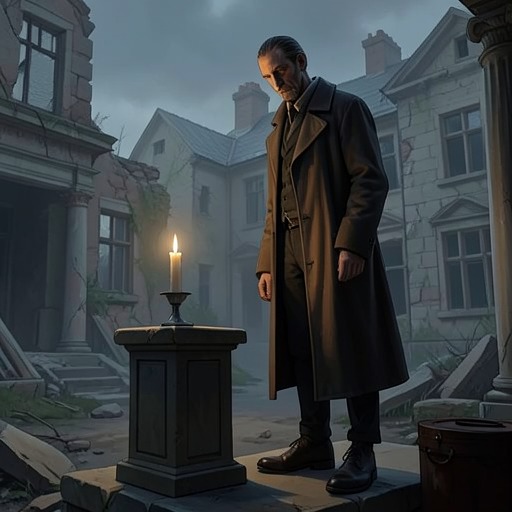
Mr. Earnshaw brings Heathcliff home from Liverpool
Wuthering HeightsMr. Earnshaw brings Heathcliff home from Liverpool is the foundational event of Emily Brontë's Wuthering Heights, the moment a nameless, starving, dark-skinned child from the streets of Liverpool is adopted into the Earnshaw household, setting in motion the novel's central conflicts of love, class, and revenge. This single act of charity, undertaken on a sixty-mile walking journey, introduces the figure who will come to dominate and ultimately destroy two families, and it establishes the racial and social otherness that marks Heathcliff for mistreatment from his first appearance. The event is narrated retrospectively by Ellen Dean, who was present as a child, and its consequences ripple through every subsequent generation of the novel's characters, making it the true origin point of the tragedy that unfolds at Wuthering Heights and Thrushcross Grange.
The Journey to Liverpool and the Discovery
The event begins on a fine summer morning at the beginning of harvest, when Mr. Earnshaw, the old master of Wuthering Heights, comes downstairs dressed for a journey and announces he is going to Liverpool. He promises to bring presents to his children, asking his son Hindley what he would like, and Hindley names a fiddle. He then asks Miss Cathy, who is hardly six years old but can already ride any horse in the stable, and she chooses a whip. He does not forget Ellen Dean, who is eating porridge with the children, and promises her a pocketful of apples and pears. He kisses his children, says goodbye, and sets off on foot, a journey of sixty miles each way, a long spell indeed.
The three days of his absence seem a long while to the family, and little Cathy often asks when he will be home. Mrs. Earnshaw expects him by supper-time on the third evening and puts the meal off hour after hour, but there are no signs of his coming. The children grow tired of running down to the gate to look, and it grows dark. She would have them to bed, but they beg sadly to be allowed to stay up. Just about eleven o'clock, the door-latch is raised quietly, and in steps the master. He throws himself into a chair, laughing and groaning, and bids them all stand off, for he is nearly killed and would not have such another walk for the three kingdoms.
The Arrival of the Strange Child
Mr. Earnshaw opens his great-coat, which he holds bundled up in his arms, and reveals the cause of his exhaustion and his delay. He presents the child to his wife with the words, 'See here, wife! I was never so beaten with anything in my life: but you must e'en take it as a gift of God; though it's as dark almost as if it came from the devil.' The family crowds round, and over Miss Cathy's head, Ellen Dean gets a peep at a dirty, ragged, black-haired child, big enough both to walk and talk, its face looking older than Catherine's. When set on its feet, it only stares round and repeats over and over again some gibberish that nobody can understand.
Mrs. Earnshaw is ready to fling it out of doors, flying up and asking how he could fashion to bring that gipsy brat into the house when they have their own bairns to feed and fend for. The master tries to explain the matter, but he is really half dead with fatigue. Ellen Dean makes out, amongst the scolding, a tale of his seeing the child starving, houseless, and as good as dumb in the streets of Liverpool, where he picked it up and inquired for its owner. Not a soul knew to whom it belonged, he said, and his money and time being both limited, he thought it better to take it home with him at once than run into vain expenses there, because he was determined he would not leave it as he found it. The conclusion is that the mistress grumbles herself calm, and Mr. Earnshaw tells Ellen to wash the child, give it clean things, and let it sleep with the children.
The children's reaction to the stranger is immediate and telling. Hindley and Cathy content themselves with looking and listening till peace is restored, then both begin searching their father's pockets for the presents he had promised them. Hindley, a boy of fourteen, draws out what had been a fiddle, crushed to morsels in the great-coat, and blubbers aloud. Cathy, when she learns the master has lost her whip in attending on the stranger, shows her humour by grinning and spitting at the stupid little thing, earning for her pains a sound blow from her father to teach her cleaner manners. They entirely refuse to have the child in bed with them, or even in their room, and Ellen Dean, having no more sense, puts it on the landing of the stairs, hoping it might be gone on the morrow. By chance, or else attracted by hearing his voice, it creeps to Mr. Earnshaw's door, and there he finds it on quitting his chamber. Inquiries are made as to how it got there, Ellen is obliged to confess, and in recompense for her cowardice and inhumanity she is sent out of the house.
Naming and Early Life at Wuthering Heights
This is Heathcliff's first introduction to the family. On coming back a few days afterwards, Ellen Dean finds they have christened him 'Heathcliff': it is the name of a son who died in childhood, and it has served him ever since, both for Christian and surname. The naming is significant: the child is given no identity of his own, but is slotted into a dead son's place, a substitution that foreshadows his entire ambiguous position in the family. Miss Cathy and he are now very thick, but Hindley hates him, and Ellen Dean confesses she does the same, and they plague and go on with him shamefully, for she is not reasonable enough to feel her injustice, and the mistress never puts in a word on his behalf when she sees him wronged.
Heathcliff seems a sullen, patient child, hardened, perhaps, to ill-treatment. He would stand Hindley's blows without winking or shedding a tear, and Ellen's pinches move him only to draw in a breath and open his eyes, as if he had hurt himself by accident and nobody was to blame. This endurance makes old Earnshaw furious when he discovers his son persecuting the poor fatherless child, as he calls him. He takes to Heathcliff strangely, believing all he says (for that matter, he says precious little, and generally the truth), and petting him up far above Cathy, who is too mischievous and wayward for a favourite. From the very beginning, he breeds bad feeling in the house, and at Mrs. Earnshaw's death, which happens in less than two years after, the young master has learned to regard his father as an oppressor rather than a friend, and Heathcliff as a usurper of his parent's affections and his privileges, and he grows bitter with brooding over these injuries.
The Child's Otherness and Its Consequences
The child's appearance and origins mark him as an outsider in ways that the novel never fully resolves. Mr. Linton, the elder, when he later encounters Heathcliff at Thrushcross Grange, declares he is 'that strange acquisition my late neighbour made, in his journey to Liverpool—a little Lascar, or an American or Spanish castaway.' Mrs. Linton calls him 'a wicked boy, at all events, and quite unfit for a decent house.' These racialized descriptions—gipsy, Lascar, castaway—establish Heathcliff's otherness as a permanent feature of his identity, an otherness that justifies his mistreatment in the eyes of the respectable families and that fuels his lifelong sense of grievance and his drive for revenge. The old master's act of charity, meant to rescue a starving child, instead plants a figure of radical difference in the heart of the Yorkshire moors, a figure whose very presence destabilizes the social order.
The consequences of this single act are vast and extend across the entire novel. Heathcliff's presence in the household poisons the relationship between Hindley and his father, turning the young master bitter and resentful. It creates the intense bond between Heathcliff and Catherine, a bond that will define both their lives and lead to Catherine's disastrous marriage to Edgar Linton. It sets the stage for Heathcliff's eventual return as a wealthy man, his systematic acquisition of Wuthering Heights through Hindley's mortgaged debts, and his cruel manipulation of the next generation. Ellen Dean's account of the event, told to Mr. Lockwood, establishes the economic and emotional stakes: Heathcliff, the nameless foundling, will become the master of Wuthering Heights, reducing Hareton, the rightful heir, to a state of complete dependence on his father's inveterate enemy. The old master's kindness, born of a determination not to leave the child as he found it, becomes the engine of a multi-generational tragedy of dispossession and revenge.
The Legacy of the Adoption
The event's significance is underscored by its echoes throughout the novel. Heathcliff's own later actions—his desire to secure his son Linton's inheritance, his manipulation of wills and property—are all rooted in his experience of being a dispossessed outsider. The old master's act of bringing the child home is the first in a series of adoptions, inheritances, and usurpations that structure the plot. Even at the novel's end, when Heathcliff dies and the 'lawful master and the ancient stock' are restored to their rights, the memory of that first journey to Liverpool lingers. Joseph, the old servant, thanks God that the ancient stock is restored, but the restoration is only possible because of the chaos Heathcliff, the Liverpool foundling, unleashed. The event is thus not merely a backstory but the primal scene of the novel, the moment from which all its conflicts, its loves, and its hatreds flow. It is the act of charity that becomes a curse, the gift of a home that becomes a lifelong war for possession of that home and everything it represents.